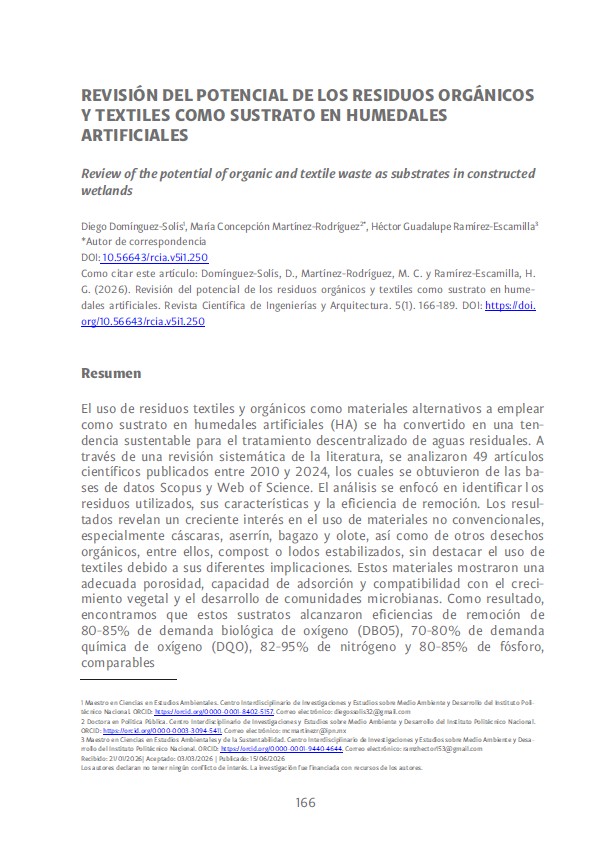
Revisión del potencial de los residuos orgánicos y textiles como sustrato en humedales artificiales
Review of the potential of organic and textile waste as substrates in constructed wetlands
DOI:
https://doi.org/10.56643/rcia.v5i1.250Palabras clave:
Desarrollo sustentable, Medio ambiente, Recursos naturales, Humedales artificiales, SustratoResumen
El uso de residuos textiles y orgánicos como materiales alternativos a emplear como sustrato en humedales artificiales (ha) se ha convertido en una tendencia sustentable para el tratamiento descentralizado de aguas residuales. A través de una revisión sistemática de la literatura, se analizaron 49 artículos científicos publicados entre 2010 y 2024, los cuales se obtuvieron de las bases de datos Scopus y Web of Science. El análisis se enfocó en identificar los residuos utilizados, sus características y la eficiencia de remoción. Los resultados revelan un creciente interés en el uso de materiales no convencionales, especialmente cáscaras, aserrín, bagazo y olote, así como de otros desechos orgánicos, entre ellos, compost o lodos estabilizados, sin destacar el uso de textiles debido a sus diferentes implicaciones. Estos materiales mostraron una adecuada porosidad, capacidad de adsorción y compatibilidad con el crecimiento vegetal y el desarrollo de comunidades microbianas. Como resultado, encontramos que estos sustratos alcanzaron eficiencias de remoción de 80-85% de demanda biológica de oxígeno (dbo5), 70-80% de demanda química de oxígeno (dqo), 82-95% de nitrógeno y 80-85% de fósforo, comparables e incluso superiores a las logradas con materiales tradicionales como grava, arena o tezontle. En conclusión, su beneficio no sólo involucra la remoción de contaminantes sino también la disminución de costos en la construcción de ha y el fortalecimiento de estrategias de economía circular.
Referencias
Agaton, C. B. (2024). Real Options Analysis of Constructed Wetlands as Nature-Based Solutions to Wastewater Treatment Under Multiple Uncertainties: A Case Study in the Philippines. Sustainability, 16(22), 9797. https://doi.org/10.3390/su16229797
Andreo-Martínez, P., García-Martínez, N., y Almela, L. (2016). Domestic Wastewater Depuration Using a Horizontal Subsurface Flow Constructed Wetland and Theoretical Surface Optimization: A Case Study under Dry Mediterranean Climate. Water, 8(10), 434. https://doi.org/10.3390/w8100434
Chen, J., Deng, S., Jia, W., Li, X., y Chang, J. (2021). Removal of multiple heavy metals from mining-impacted water by biochar-filled constructed wetlands: Adsorption and biotic removal routes. Bioresource technology, 331, 125061. https://doi.org/10.1016/j.biortech.2021.125061.
Chen, Y., Li, T., Hu, H., Ao, H., Xiong, X., Shi, H., y Wu, C. (2021). Transport and fate of microplastics in constructed wetlands: A microcosm study. Journal of hazardous materials, 415, 125615. https://doi.org/10.1016/j.jhazmat.2021.125615.
Chen, J., Li, X., Jia, W., Shen, S., Deng, S., Ji, B., y Chang, J. (2020). Promotion of bioremediation performance in constructed wetland microcosms for acid mine drainage treatment by using organic substrates and supplementing domestic wastewater and plant litter broth. Journal of hazardous materials, 404 Pt A, 124125. https://doi.org/10.1016/j.jhazmat.2020.124125.
Cui, L., Zhu, X., M., Ouyang, Y., Dong, M., Zhu, W., y Luo, S. (2008). Phosphorus Sorption Capacities and Physicochemical Properties of Nine Substrate Materials for Constructed Wetland. Archives of Environmental Contamination and Toxicology, 55, 210-217. https://doi.org/10.1007/s00244-007-9109-y.
Cun, D., Wang, H., Jiang, M., Lin, R., Deng, S., Chang, J., Zhao, Y., y Duan, C. (2024). Effective remediation of agricultural drainage at three influent strengths by bioaugmented constructed wetlands filled with mixture of iron carbon and organic solid substrates: Performance and mechanisms. The Science of the total environment, 947, 174615. https://doi.org/10.1016/j.scitotenv.2024.174615
De Souza, T. O., De Assis, L. D. S., Da Silva Marques, D., De Freitas Coelho, A. L., Cecon, P. R., y Borges, A. C. (2024). High-loaded tidal flow constructed wetlands coupled with microbial fuel cells: effects of the vegetation and filling material size. Environmental Science and Pollution Research. https://doi.org/10.1007/s11356-024-35622-7
Escobar, L. a. G. (2025). Descripción de un nuevo humedal cauce aislado de río en Colombia. Revista Chapingo Serie Agricultura Tropical, 5. https://doi.org/10.5154/r.rchsat.2024.05.08
Fontalvo-Buelvas, J. C. (Coord.). (2023). Huertos en instituciones de educación superior: Relatos y experiencias desde México. Comunicación Científica. https://doi.org/10.52501/cc.191
Gross, M., Formica, S., Gandy, L., y Hestir, J. (2020). A Comparison of Local Waste Materials for Sulfate-Reducing Wetlands Substrate. 179-185. https://doi.org/10.1201/9781003069997-21.
Herrera-Melián, J. A., Torres-Padrón, M. E., Betancor-Abreu, A., Sosa-Ferrera, Z., Santana- Rodríguez, J. J., Martín-González, M. A., Araña, J., y Guedes-Alonso, R. (2014). Clogging reduction and removal of hormone residues with laboratory-scale vertical flow organic-based filter and hybrid wetland. International Journal of Environmental Science and Technology, 12(3), 1039-1052. https://doi.org/10.1007/s13762-013-0495-6
Hu, S., He, R., Zeng, J., Zhao, D., Wang, S., He, F., Yu, Z., y Wu, Q. L. (2022). Lower Compositional Variation and Higher Network Complexity of Rhizosphere Bacterial Community in Constructed Wetland Compared to Natural Wetland. Microbial Ecology, 85(3), 965-979. https://doi.org/10.1007/s00248-022-02040-6
Irshad, S., Xie, Z., Qing, M., Ali, H., Ali, I., Ahmad, N., Khan, M., y Nawaz, A. (2024). Application of coconut shell activated carbon filter in vertical subsurface flow constructed wetland for enhanced multi-metal bioremediation and antioxidant response of Salvinia cucullate. Environmental pollution, 123597. https://doi.org/10.1016/j.envpol.2024.123597.
Ji, Z., Tang, W., y Pei, Y. (2021). Constructed wetland substrates: A review on development, function mechanisms, and application in contaminants removal. Chemosphere, 286 Pt 1, 131564. https://doi.org/10.1016/j.chemosphere.2021.131564.
Junca-Gómez, D. A., Hernández-Alarcón, M. E., y Marín-Muñiz, J. L. (2024). Charlas educativas no formales en parques de Xalapa, Veracruz: Una visión hacia el conocimiento y conservación de humedales naturales urbanos. Revista Eduscientia. Divulgación de la Ciencia Educativa, 1(especial), 61-72. https://www.eduscientia.com/index.php/journal/article/view/425
Khalifa, M., El‐Reash, Y., Ahmed, M., y Rizk, F. (2020). Effect of media variation on the removal efficiency of pollutants from domestic wastewater in constructed wetland systems. Ecological Engineering, 143, 105668.
Kivaisi, A. R., y Zhao, Q. (2024). Improved mini-batch multiple augmentation for low-resource spoken word recognition. Expert Systems with Applications, 252, 124157. https://doi.org/10.1016/j.eswa.2024.124157
Kong, F., Wang, J., Hou, W., Cui, Y., Yu, L., Zhang, Y., y Wang, S. (2022). Influence of modified biochar supported sulfidation of nano-zero-valent-iron (S-nZVI/BC) on nitrate removal and greenhouse gas emission in constructed wetland. Journal of Environmental Ssciences, 125, 568-581 . https://doi.org/10.1016/j.jes.2022.02.040.
Korboulewsky, N., Wang, R., y Baldy, V. (2012). Purification processes involved in sludge treatment by a vertical flow wetland system: Focus on the role of the substrate and plants on N and P removal. Bioresource Technology, 105, 9-14. https://doi.org/10.1016/j.biortech.2011.11.037
Latip, S. N. H. M., Damanhuri, S. N. A., Ibrahim, N. D., Chin, K. B., y Nasruddin, M. F. (2022). Utilising Constructed Wetlands From Water Hyacinth for Wastewater Treatment in Oxidation Ponds. International Journal of Integrated Engineering, 14(5). https://doi.org/10.30880/ijie.2022.14.05.016
Lin, Z., Li, M., Yan, P., Zhang, J., Xie, H., & Wu, H. (2025). Constructed Wetlands for Wastewater Treatment and Reuse: Two Decades of Experience from China. Environmental Research, 121781. https://doi.org/10.1016/j.envres.2025.121781
Long, Y., Yu, G., Wang, J., y Zheng, D. (2024). Cadmium removal by constructed wetlands containing different substrates: performance, microorganisms and mechanisms. Bioresource Technology, 131561. https://doi.org/10.1016/j.biortech.2024.131561.
López-Rosas, H., Moreno-Casasola, P., y Peralta-Peláez, L. A. (2024). Herramientas para lograr cambios positivos en la actitud hacia el agua y los humedales. Revista Eduscientia. Divulgación de la Ciencia Educativa, 1(especial), 127-137. https://www.eduscientia.com/index.php/journal/article/view/429
Lopopolo, L., Herrera-Melián, J. A., Arocha-Espiau, D., Naghoum, I., Ranieri, E., Guedes- Alonso, R., y Sosa-Ferrera, Z. (2025). Upgrading a horizontal surface flow constructed wetland with forest waste and aeration. Journal of Environmental Management, 376, 124468. https://doi.org/10.1016/j.jenvman.2025.124468
Nata, I., Irawan, C., Putra, M., Hudha, M., Syarkani, M., y Naufal, A. (2024). Simultaneous adsorption of Cr(III) ions and contaminants on Sugarcane bagasse/rice husk fiber-based amine magnetic biocomposite. Journal of Hazardous Materials Advances. https://doi.org/10.1016/j.hazadv.2024.100412.
Nuamah, L., Li, Y., Pu, Y., Nwankwegu, A., Zhang, H., Norgbey, E., Banahene, P., y Bofah- Buoh, R. (2020). Constructed wetlands, status, progress, and challenges. The need for critical operational reassessment for a cleaner productive ecosystem. Journal of Cleaner Production, 269, 122340. https://doi.org/10.1016/j.jclepro.2020.122340.
Panghal, V., Singh, A., Hooda, V., Arora, D., Bhateria, R., y Kumar, S. (2024). Recent progress, challenges, and future prospects in constructed wetlands employing biochar as a substrate: a comprehensive review. Environmental Science and Pollution Research International. https://doi.org/10.1007/s11356-024-35846-7.
Paredes, D. (2007). En Memorias de la conferencia internacional de Humedales, Universidad Tecnológica de Pereira, Facultad de ciencias ambientales, Pereira, Risaralda, Colombia.
Patyal, V., Jaspal, D., & Khare, K. (2024). Evaluation of composite matrix in constructed wetland for phosphorus removal. Bioresource Technology Reports. https://doi.org/10.1016/j.biteb.2024.101870.
Pinho, H. J., y Mateus, D. M. (2021b). Valorization of solid waste in subsurface flow constructed wetlands based on renewable modular structures: A contribution to a circular economy. En Circular economy and sustainability (pp. 215-233). https://doi.org/10.1016/b978-0-12-821664-4.00019-4
Reed, C., Crites, R. W, Middlebrooks, E. J. (1995). Natural systems for waste management and treatment. Mc Graw Hill Co.
Saeed, T., y Sun, G. (2013). A lab-scale study of constructed wetlands with sugarcane bagasse and sand media for the treatment of textile wastewater. Bioresource Technology, 128, 438-447. https://doi.org/10.1016/j.biortech.2012.10.052.
Saeed, T., Miah, M., y Yadav, A. (2022). Development of electrodes integrated hybrid constructed wetlands using organic, construction, and rejected materials as filter media: Landfill leachate treatment. Chemosphere,135273. https://doi.org/10.1016/j.chemosphere.2022.135273
Santos, J., Rodrigues, S., Magalhães, M., Rodrigues, K., Pereira, L., y Marinho, G. (2024). A state-of-the-art review (2019-2023) on constructed wetlands for greywater treatment and reuse. Environmental Challenges, 16, 100973. https://doi.org/10.1016/j.envc.2024.100973
Sharma, M., Sharma, N., y Kanwar, R. (2023). Assessment of agriwaste derived substrates to grow ornamental plants for constructed wetland. Environmental Science and Pollution Research, 30, 84645-84662. https://doi.org/10.1007/s11356-023-28364-5.
Sharma, M., Sharma, N., y Kanwar, R. (2024). Performance analysis of mesocosm-constructed wetland containing agricultural waste-derived substrates for treatment of wastewater. Environmental monitoring and assessment, 196(12), 1220. https://doi.org/10.1007/s10661-024-13411-6
Singh, S., y Chakraborty, S. (2020). Performance of organic substrate amended constructed wetland treating acid mine drainage (AMD) of North-Eastern India. Journal of Hazardous Materials, 397, 122719. https://doi.org/10.1016/j.jhazmat.2020.122719
Sun, Q., Wang, X., y Wang, L. (2019). Ecological impact of watershed water pollution control on coastal tourist scenic spots. The International Journal of Low Carbon Technologies, 15(1), 84-88. https://doi.org/10.1093/ijlct/ctz060
Vymazal, J. (2014). Constructed wetlands for treatment of industrial wastewaters: a review. Ecological Engineering, 73, 724-751. https://doi.org/10.1016/j.ecoleng.2014.09.034
Wang, Y., Cai, Z., Sheng, S., Pan, F., Chen, F., y Fu, J. (2019). Comprehensive evaluation of substrate materials for contaminants removal in constructed wetlands. The Science of the Total Environment, 701, 134736. https://doi.org/10.1016/j.scitotenv.2019.134736
Wang, T., Liu, R., O’Meara, K., Mullan, E., y Zhao, Y. (2018). Assessment of a Field Tidal Flow Constructed Wetland in Treatment of Swine Wastewater: Life Cycle Approach. Water, 10(5), 573. https://doi.org/10.3390/w10050573
Wang, Y., Zhou, P., Song, X., y Xu, Z. (2022). Simultaneous nitrification and denitrification in a PCL-supported constructed wetland with limited aeration. Environmental Science and Pollution Research, 30, 22606-22616. https://doi.org/10.1007/s11356-022-23748-5.
Wdowczyk, A., Szymańska-Pulikowska, A., y Gałka, B. (2022). Removal of selected pollutants from landfill leachate in constructed wetlands with different filling. Bioresource Technology, 353, 127136. https://doi.org/10.1016/j.biortech.2022.127136
Yakar, A., Türe, C., Türker, O. C., Vymazal, J., y Saz, Ç. (2018). Impacts of various filtration media on wastewater treatment and bioelectric production in up-flow constructed wetland combined with microbial fuel cell (UCW-MFC). Ecological Engineering, 117, 120-132. https://doi.org/10.1016/j.ecoleng.2018.03.016
Yang, Y., Zhao, Y., Liu, R., y Morgan, D. (2018). Global development of various emerged substrates utilized in constructed wetlands. Bioresource Technology, 261, 441-452. https://doi.org/10.1016/j.biortech.2018.03.085.
Yang, C., Zhang, X., Tang, Y., Jiang, Y., Xie, S., Zhang, Y., y Qin, Y. (2022). Selection and optimization of the substrate in constructed wetland: A review. Journal of Water Process Engineering, 49, 103140. https://doi.org/10.1016/j.jwpe.2022.103140
Yaashikaa, P., Kumar, S., y Varjani, S. (2021). Valorization of agro-industrial wastes for biorefinery process and circular bioeconomy: A critical review. Bioresource Technology, 126126. https://doi.org/10.1016/j.biortech.2021.126126.
Descargas
Publicado
Número
Sección
Licencia
Derechos de autor 2026 Diego Domínguez Solís, María Concepción Martínez-Rodríguez, H´éctor Guadalupe Ramírez-Escamilla

Esta obra está bajo una licencia internacional Creative Commons Atribución 4.0.
Los autores/as que publiquen en esta revista aceptan las siguientes condiciones:
- Los autores/as conservan los derechos de autor y ceden a la revista el derecho de la primera publicación, con el trabajo registrado con la licencia de atribución de Creative Commons 4.0, que permite a terceros utilizar lo publicado siempre que mencionen la autoría del trabajo y a la primera publicación en esta revista.
- Los autores/as pueden realizar otros acuerdos contractuales independientes y adicionales para la distribución no exclusiva de la versión del artículo publicado en esta revista (p. ej., incluirlo en un repositorio institucional o publicarlo en un libro) siempre que indiquen claramente que el trabajo se publicó por primera vez en esta revista.
- Se permite y recomienda a los autores/as a compartir su trabajo en línea (por ejemplo: en repositorios institucionales o páginas web personales) antes y durante el proceso de envío del manuscrito, ya que puede conducir a intercambios productivos, a una mayor y más rápida citación del trabajo publicado.