Sustainable utilization of orejón (Enterolobium cyclocarpum) for the production of a biodegradable soap
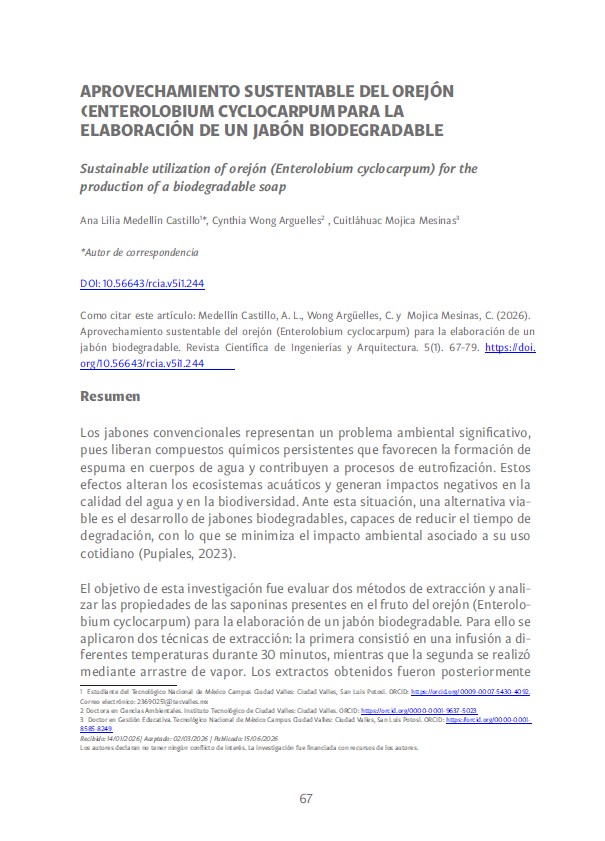
Sustainable utilization of orejón (Enterolobium cyclocarpum) for the production of a biodegradable soap
DOI:
https://doi.org/10.56643/rcia.v5i1.244Keywords:
arrastre de vapor, biodegradable, eutrofización, jabones ecológicos, saponinas vegetalesAbstract
Conventional soaps represent a significant environmental problem, as they release persistent chemical compounds that promote foam formation in bodies of water and contribute to eutrophication processes. These effects alter aquatic ecosystems and generate negative impacts on water quality and biodiversity. In response to this situation, a viable alternative is the development of biodegradable soaps, capable of reducing degradation time and minimizing the environmental impact associated with their daily use (Pupiales, 2023).
The objective of this research was to evaluate two extraction methods and analyze the properties of saponins present in the fruit of *Enterolobium cyclocarpum* (commonly known as orejón) for the production of a biodegradable soap. Two extraction techniques were applied: the first consisted of an infusion at different temperatures for 30 minutes, while the second was performed through steam distillation. The obtained extracts were subsequently filtered and centrifuged at 2700 rpm for 45 minutes, using carbopol as a gelling agent to improve product quality (Ribeiro, 2014).
In order to determine the viability of the extracts, qualitative and quantitative tests were carried out, including the evaluation of extraction time, foam formation and persistence, saponin percentage, as well as organoleptic characteristics such as color, odor, and turbidity. The results showed that the steam distillation method yielded 1.1% saponins and a foam persistence of 95 minutes. These values surpassed those of commercially available biodegradable soaps, demonstrating greater foam stability and lower residue presence (Khoang et al, 2022).
In conclusion, the findings suggest that soap produced from the orejón fruit represents a sustainable alternative with low environmental impact compared to conventional products, offering benefits both in terms of efficiency and ecological protection (Chris, 2011).
References
Augustin, J., Kusina, V., Anderson, S. y Bak, S. (2011). Molecular activities, biosynthesis and evolution of triterpenoid saponins. Phytochemistry, 72(6), 435-457.
Babayemi, O. J. (2006). Antinutritional factors, nutritive value and in vitro gas production of foliage and fruits of Enterolobium cyclocarpum. World Journal of Zoology, 1(2), 113-117.
Burkart, A. (1978). Flora ilustrada de Entre Ríos (Argentina), parte III. Dicotiledóneas Metaclamídeas. A: Salicales a Rosales (Incluso Leguminosas). Editorial Instituto Nacional Agropecuaria, Colección Científica inta.
Burkart, L. R. (1993). Leguminosae. En A. L. Cabrera (Ed.), Flora de la provincia de Buenos Aires (vol. 5, pp. 1-552). Instituto Nacional de Tecnología Agropecuaria (inta).
Chris (2011). Saponinas: Qué son y sus usos en productos de limpieza natural. Vida Ecológica. Recuperado de https://vidaecologica.info/saponinas-que-son-y-sus-usos-en-productos-de-limpieza-natural/
El Hosry, L., Elias, V., Chamoun, V., Halawi, M., Cayot, P., Nehme, A., y Bou-Maroun, E. (2025). Maillard reaction: Mechanism, influencing parameters, advantages, disadvantages, and food industrial applications: A review. Foods, 14(11), 1881. https://doi.org/10.3390/foods14111881
Khoang, L. T., Huyen, H. T. T., Van Chung, H., Duy, L. X., Toan, T. Q., Bich, H. T., Minh, P. T. H., Pham, D. T. N., y Hien, T. T. (2022). Optimization of total saponin extraction from Polyscias fruticosa roots using the ultrasonic-assisted method and response surface methodology. Processes, 10(10), 2034. https://doi.org/10.3390/pr10102034
Pupiales Brusil, J. P. (2023). Evaluación del impacto ambiental entre productos tensoactivos: Caso shampoo convencional y shampoo ecológico. Tesis de licenciatura, Universidad Técnica del Norte.
Ribeiro, A. B., Oliveira, J. V., y Oliveira, A. P. (2014). Optimization of saponin extraction from Polyscias fruticosa using response surface methodology. Industrial Crops and Products, 52, 702-708. https://doi.org/10.1016/j.indcrop.2013.11.034
Rodríguez, R., & Fondevila, M. (2012). Effect of saponins from Enterolobium cyclocarpum on in vitro microbial fermentation of the tropical grass Pennisetum purpureum. Journal of Animal Physiology and Animal Nutrition, 96(5), 762–769. https://doi.org/10.1111/j.1439-0396.2011.01161.x
Secretaría de Economía (2018). NMX-Q-003-NYCE-2018: Jabón de tocador-especificaciones y métodos de prueba. Dirección General de Normas.
Downloads
Published
Issue
Section
License
Copyright (c) 2026 Ana Lilia Medellín Castillo, Cynthia Wong Arguelles, Cuitláhuac Mojica Mesinas

This work is licensed under a Creative Commons Attribution 4.0 International License.
Los autores/as que publiquen en esta revista aceptan las siguientes condiciones:
- Los autores/as conservan los derechos de autor y ceden a la revista el derecho de la primera publicación, con el trabajo registrado con la licencia de atribución de Creative Commons 4.0, que permite a terceros utilizar lo publicado siempre que mencionen la autoría del trabajo y a la primera publicación en esta revista.
- Los autores/as pueden realizar otros acuerdos contractuales independientes y adicionales para la distribución no exclusiva de la versión del artículo publicado en esta revista (p. ej., incluirlo en un repositorio institucional o publicarlo en un libro) siempre que indiquen claramente que el trabajo se publicó por primera vez en esta revista.
- Se permite y recomienda a los autores/as a compartir su trabajo en línea (por ejemplo: en repositorios institucionales o páginas web personales) antes y durante el proceso de envío del manuscrito, ya que puede conducir a intercambios productivos, a una mayor y más rápida citación del trabajo publicado.