
Waste Management in Mexico City: Mathematical Models and the Kuznets Curve
Waste Management in Mexico City: Mathematical Models and the Kuznets Curve
DOI:
https://doi.org/10.56643/rcia.v5i1.248Keywords:
optimización, gestión, contaminación, modelos matemáticos, curva de KuznetsAbstract
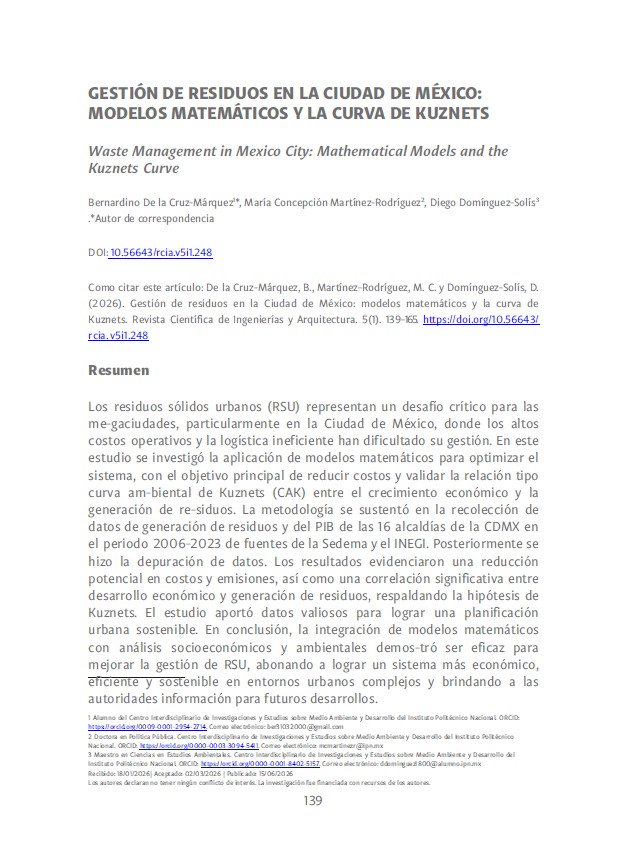
Municipal solid waste (MSW) represents a critical challenge for megacities, particularly in Mexico City, where high operating costs and inefficient logistics have hampered its management. This study investigated the application of mathematical models to optimize the system, with the main objective of reducing costs and validating the Kuznets Environmental Curve (KEC) relationship between economic growth and waste generation. The methodology involved collecting data on waste generation and GDP from the 16 municipalities of Mexico City for the period 2006-2023, from sources such as SEDEMA and INEGI. The data was then cleaned. The results showed a potential reduction in costs and emissions and a significant correlation between economic development and waste generation, supporting Kuznets' hypothesis. The study provided valuable data for sustainable urban planning. In conclusion, the integration of mathematical models with socioeconomic and environmental analyses proved effective in improving MSW management, achieving a more economical, efficient, and sustainable system in complex urban environments, and providing authorities with information for future developments.
References
Abrete, G., y Ferraris, M. (2010). The Environmental Kuznets Curve in the Municipal Solid Waste Sector.
Aguilar-Rodríguez, M. E. (2023). Aprendizajes sociales relacionados con la gestión de residuos en la población adulta. Eduscientia. Divulgación de la Ciencia Educativa, 6(12), 194-207.
Baltagi, B. H. (2005). Econometrics (3.ª ed). Springer-Verlag.
Benítez-Bravo, R., Gómez-González, R., Rivas-García, P., Botello-Álvarez, J. E., Huerta-Guevara, O. F., García-León, A. M., y Rueda-Avellaneda, J. F. (2021). Optimization of municipal solid waste collection routes in a Latin-American context. Journal of the Air & Waste Management Association, 71(11), 1415-1427. https://doi.org/10.1080/10962247.2021.1957040
Botello-Álvarez, J. E., Rivas-García, P., Fausto-Castro, L., Estrada-Baltazar, A., y Gómez-González, R. (2018). Informal collection, recycling and export of valuable waste as transcendental factor in the municipal solid waste management: A Latin-American reality. Journal of Cleaner Production, 182, 485-495.
Catalán, H. (2014) Curva ambiental de Kuznets: implicaciones para un crecimiento sustentable, Revista Científica Economía Informa, 24.
Cavalheiro, E. A., Pierre, F., Rodriguez, A. M., Thue, P. S. y Kontz, L. B. (2023). Granger Causality and Kuznets Environmental Curve: An Analysis of the Relationship between Municipal Solid Waste Collection, Per Capita Income and GDP Per Capita in Brazil. International Journal of Managerial Studies and Research (IJMSR), 11(6), 24-35. https://doi.org/10.20431/2349-0349.1106004
Díaz Del Águila, C. R., y Rodríguez Guirola, J. H. (2019). Alternativas para la gestión de residuos sólidos en la Universidad Católica de El Salvador. Anuario de Investigación, 8, 123-133.
Evalúa CDMX (2018). Índice de Bienestar Social de la Ciudad de México.
Gobierno del Distrito Federal (2010). Informe Económico del Gobierno del Distrito Federal. https://servidoresx3.finanzas.cdmx.gob.mx/egresos/Proy_2010/desempEconomico2010.pdf
Greene, W.H. (2000). Econometric Analysis (4ª ed.). Prentice Hall.
Gutiérrez Espinosa, I. (2018). Uso de algoritmos heurísticos para el diseño de rutas de recolección de residuos sólidos urbanos. Tesis de maestría, Universidad Politécnica de Tulancingo. Repositorio Institucional UPT.
Hsiao C. (2003). Analysis of Panel Data (2ª ed.). Cambridge University Press.
Instituto Nacional de Estadística y Geografía (2020a). Censo de Población y Vivienda 2020. Panorama sociodemográfico de la Ciudad de México. INEGI.
Instituto Nacional de Estadística y Geografía (2020b). Censo de Población y Vivienda 2020. Fichas por alcaldía de la Ciudad de México. INEGI.
Instituto Nacional de Estadística y Geografía (2023). Indicadores Económicos de la Ciudad de México. Secretaría de Desarrollo Económico de la CDMX/ INEGI. https://www.sedeco.cdmx.gob.mx/storage/app/media/uploaded-files/indicadores-economicos-de-la-cdmx.pdf
Jiménez-Carrasco, J., y Segura-Salazar, C. (2024). Educación ambiental universitaria y sustentabilidad: Brecha entre preocupación y acción. Revista Investigium IRE: Ciencias Sociales y Humanas, 15(2), 55-69. DOI: https://doi.org/10.15658/INVESTIGIUMIRE.241502.04
Konat, G., Dürrü, Z., y Han, A. (2024). Investigation of waste Kuznets curve hypothesis in selected OECD member EU countries: Panel data analysis. Akademik Yaklaşımlar Dergisi. https://doi.org/10.54688/ayd.1473301
López-Ibáñez, M., y Blum, C. (2010). Beam-ACO for the travelling salesman problem with time windows. Computers & Operations Research, 37(9), 1570-1583. https://doi.org/10.1016/j.cor.2009.11.015
Secretaría de Desarrollo Económico (s. f.). La actividad económica de la Ciudad de México. Gobierno de la Ciudad de México. https://www.sedeco.cdmx.gob.mx/storage/app/media/uploaded-files/evolucion-de-la-actividad-economica-cdmx.pdf
Trujillo Lora, J. C., Carrillo Bermúdez, B., Charris Vizcaíno, C. A., e Iglesias Pinedo, W. J. (2013). The environmental Kuznets curve (EKC): An analysis landfilled solid waste In Colombia. Revista Facultad de Ciencias Económicas: Investigación y Reflexión, 21(2), 7-16.
Yu, Z. (2021). Assessment of environmental Kuznets curves for industrial solid waste in China. Tesis de maestría, Cornell University. Cornell Theses and Dissertations.
Downloads
Published
Issue
Section
License
Copyright (c) 2026 Bernardino De la Cruz Marquez, María Concepción Martínez Rodríguez, Diego Domínguez Solís

This work is licensed under a Creative Commons Attribution 4.0 International License.
Los autores/as que publiquen en esta revista aceptan las siguientes condiciones:
- Los autores/as conservan los derechos de autor y ceden a la revista el derecho de la primera publicación, con el trabajo registrado con la licencia de atribución de Creative Commons 4.0, que permite a terceros utilizar lo publicado siempre que mencionen la autoría del trabajo y a la primera publicación en esta revista.
- Los autores/as pueden realizar otros acuerdos contractuales independientes y adicionales para la distribución no exclusiva de la versión del artículo publicado en esta revista (p. ej., incluirlo en un repositorio institucional o publicarlo en un libro) siempre que indiquen claramente que el trabajo se publicó por primera vez en esta revista.
- Se permite y recomienda a los autores/as a compartir su trabajo en línea (por ejemplo: en repositorios institucionales o páginas web personales) antes y durante el proceso de envío del manuscrito, ya que puede conducir a intercambios productivos, a una mayor y más rápida citación del trabajo publicado.