
Sensitivity of biorefinery environmental impacts associated with reduced use of sodium phosphate
Sensitivity of biorefinery environmental impacts associated with reduced use of sodium phosphate
DOI:
https://doi.org/10.56643/rcia.v5i1.246Keywords:
environmental metrics, environmental sustainability, indices, life cycle assessmentAbstract
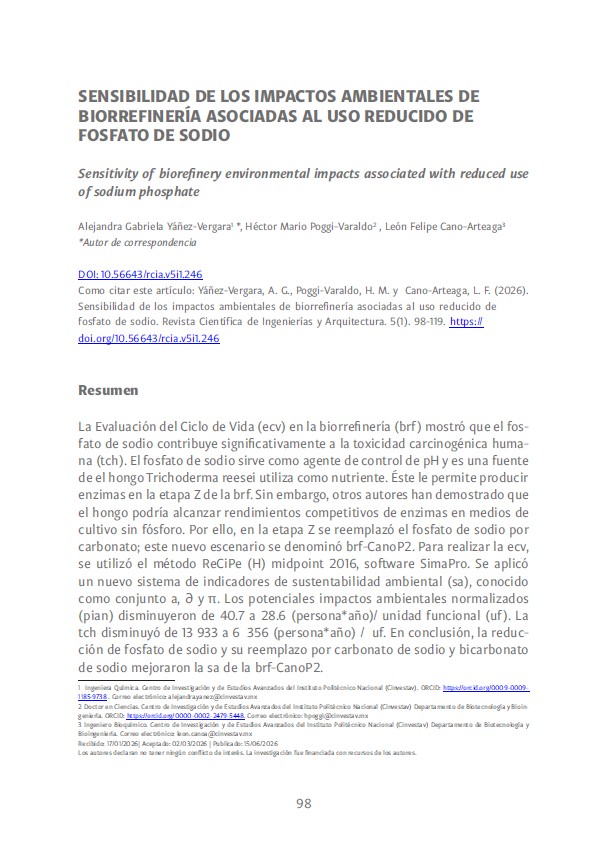
A Life Cycle Assessment (LCA) of the biorefinery (BRF) showed that sodium phosphate significantly contributed to human carcinogenic toxicity (HCT). The sodium phosphate used serves as a pH control agent and phosphorus nutrient source for the fungus Trichoderma reesei to produce enzymes in the Z stage of the BRF. However, other authors have demonstrated that the fungus could achieve competitive enzyme yields in phosphorus-free culture media. Therefore, sodium phosphate in the Z stage was replaced with carbonate; this new scenario was named BRF-CanoP2. The ReCiPe (H) midpoint 2016 method was used for the LCA in SimaPro. A new system of environmental sustainability (ES) indicators, known as the α, σ, and τ set, was applied. The potential normalized environmental impacts (PIAN) decreased from 40.7 to 28.6 (person*years)/functional unit (FU). The total human consumption (THC) decreased from 13,933 to 6,356 (person*years)/FU. In conclusion, reducing sodium phosphate use and replacing it with sodium carbonate and sodium bicarbonate improved the environmental performance of the BRF-CanoP2.
References
Ávalos-Rodríguez, M.L., Diaz-Abrego, M. y Rangel-Vargas, J. M. (2025). La sostenibilidad en los posgrados. Creación de contenidos ambientales en el Doctorado en Innovación UVEG. Revista Electrónica en Educación y Pedagogía, 9(16), 128-144. https://doi.org/10.15658/rev.electron.educ.pedagog25.06091606
Callow, N. V., Ray, C. S., Kelbly, M. A., y Ju, L. K. (2016). Nutrient control for stationary phase cellulase production in Trichoderma reesei Rut C-30. Enzyme and Microbial Technology, 82, 8-14. https://doi.org/10.1016/j.enzmictec.2015.08.012
Chen, W., Zhan, Y., Zhang, X., Shi, X., Wang, Z., Xu, S., Chang, Y., Ding, G., Li, J., y Wei, Y. (2022). Influence of carbon-to-phosphorus ratios on phosphorus fractions transformation and bacterial community succession in phosphorus-enriched composting. Bioresource Technology, 362, 127786. https://doi.org/10.1016/j.biortech.2022.127786
Escamilla-Alvarado, C. (2014). Integración de un proceso modelo de biorrefinería para la obtención de hidrógeno, metano, enzimas y sacarificados a partir de la fracción orgánica de residuos sólidos urbanos. Tesis de doctorado, Centro de Investigación y de Estudios Avanzados del Instituto Politécnico Nacional.
Escamilla-Alvarado, C., Poggi-Varaldo, H. M., y Ponce-Noyola, M. T. (2017). Bioenergy and bioproducts from municipal organic waste as alternative to landfilling: A comparative life cycle assessment with prospective application to Mexico. Environmental Science and Pollution Research, 24, 25602-25617. https://doi.org/10.1007/s11356-016-6939-z
Fava, F., Totaro, G., Diels, L., Reis, M., Duarte, J., Carioca, O. B., Poggi-Varaldo, H. M., y Ferreira, B. S. (2015). Biowaste biorefinery in Europe: Opportunities and research & development needs. New Biotechnology, 32, 100-108. https://doi.org/10.1016/j.nbt.2013.11.003
Global LCA Data Access Network (s. f.). Modified Solvay process, Hou’s process, UPR, ecoinvent 3.6, Allocation, APOS. Recuperado el 10 de julio de 2025 de https://www.globallcadataaccess.org/modified-solvay-process-hous-process-upr-ecoinvent-36-allocation-apos
Instituto Nacional de Ecología y Cambio Climático (INECC) (2020). Inventario nacional de emisiones de gases y compuestos de efecto invernadero, 1990-2019. https://www.gob.mx/inecc
International Organization for Standardization (2006). Environmental management-Life cycle assessment-Principles and framework (ISO 14040).
International Organization for Standardization (2006). Environmental management-Life cycle assessment-Requirements and guidelines (ISO 14044).
López-Hernández, V., Limón-Hernández, R. y Morales-Moguel, O. (2025). Diagnóstico de la generación de residuos en municipios del norte de Veracruz. Revista Investigium IRE: Ciencias Sociales y Humanas, 16(1), 136-158. https://doi.org/10.15658/INVESTIGIUMIRE.251601.06
Mendoza Rossano, J. A., Cruz Hernández, J., y Herrera Pérez, L. (2023). Determinación de parámetros físicos y químicos de digeridos de bagazo de agave (Agave angustifolia Haw.) obtenidos con pacas biodigestoras. Revista Chapingo Serie Agricultura Tropical, 3(2), 1-8. https://doi.org/10.5154/r.rchsagt.2023.03.10
Moreira, J. V., Silva, S. C. M., y Cremasco, M. A. (2020). Evaluation of carbon:nitrogen ratio in semi-defined culture medium to tacrolimus biosynthesis by Streptomyces tsukubaensis and the effect on bacterial growth. Biotechnology Reports, 26, e00440. https://doi.org/10.1016/J.BTRE.2020.E00440
Rachid, S., Taha, Y., Muller, E., y Benzaazoua, M. (2025). Life cycle assessment of phosphate mining and beneficiation in Morocco: Performance evaluation. Journal of Environmental Management, 373, 123453. https://doi.org/10.1016/J.JENVMAN.2024.123453
Rahimpour, H., Fahmi, A., y Zinatloo-Ajabshir, S. (2024). Toward sustainable soda ash production: A critical review on eco-impacts, modifications, and innovative approaches. Results in Engineering, 23, 102399. https://doi.org/10.1016/j.rineng.2024.102399
Ritchie, E., Boyd, P., Lawson-Halasz, A., Hawari, J., Saucier, S., Scroggins, R., y Princz, J. (2017). The ecotoxicity of zinc and zinc-containing substances in soil with consideration of metal-moiety approaches and organometal complexes. Environmental Toxicology and Chemistry, 36(12), 3324-3332. https://doi.org/10.1002/ETC.3910
Rutherford, P. M., Dudas, M. J., y Samek, R. A. (1994). Environmental impacts of phosphogypsum. Science of The Total Environment, 149(1–2), 1-38. https://doi.org/10.1016/0048-9697(94)90002-7
Secretaría de Medio Ambiente y Recursos Naturales (Semarnat) (2020). Diagnóstico básico para la gestión integral de los residuos. https://www.gob.mx/inecc
Sierra-Gachuz, H., Poggi-Varaldo, H. M., Sotelo-Navarro, P. X., Escamilla-Alvarado, C., Sojo-Benítez, A., Barrera-Cortés, J., y González-Cardoso, G. (2022). Evaluación de la sostenibilidad ambiental de las biorrefinerías de la familia H-M-Z-S. En P. Sotelo-Navarro et al. (Eds.), Ambiente y bioenergía. Perspectivas y avances de la sostenibilidad (pp. 2-12). ABIAER A. C.
Tayibi, H., Choura, M., López, F. A., Alguacil, F. J., y López-Delgado, A. (2009). Environmental impact and management of phosphogypsum. Journal of Environmental Management, 90(8), 2377-2386. https://doi.org/10.1016/J.JENVMAN.2009.03.007
Tyagi, S., Mani, S., Tyagi, S., y Mani, S. (2023). Media and buffer preparation for cell culture. En Basic Cell Culture Protocols (pp. 77-88). Primavera. https://doi.org/10.1007/978-3-031-19485-6_5
Victorino Ramírez, L., y Velázquez Cigarroa, E. (2018). Educación ambiental, cambio climático y sustentabilidad: Saberes locales y multidisciplinarios para el desarrollo. Universidad Autónoma Chapingo. ISBN: 978-607-12-0495-0
Yáñez-Vergara, A. G. (2022). Análisis de sustentabilidad de dos escenarios de gestión de residuos urbanos: biorrefinería que genera bioenergías, enzimas y nanobiopartículas (H-M-Z-S-NN) e incineración con recuperación de energía. Tesis de maestría, Centro de Investigación y de Estudios Avanzados del Instituto Politécnico Nacional.
Yáñez-Vergara, A., Poggi-Varaldo, H. M., Pérez-Morales, G., Sotelo-Navarro, P. X., Padilla-Viveros, A., Matsumoto-Kuwahara, Y., Ponce-Noyola, T., y Sánchez-Pérez, R. (2025). Evaluation of environmental sustainability of biorefinery and incineration with energy recovery based on life cycle assessment. Fermentation, 11(4), 232. https://doi.org/10.3390/fermentation11040232
Downloads
Published
Issue
Section
License
Copyright (c) 2026 Alejandra Gabriela Yáñez Vergara, Héctor Mario Poggi Varaldo, León Felipe Cano Arteaga

This work is licensed under a Creative Commons Attribution 4.0 International License.
Los autores/as que publiquen en esta revista aceptan las siguientes condiciones:
- Los autores/as conservan los derechos de autor y ceden a la revista el derecho de la primera publicación, con el trabajo registrado con la licencia de atribución de Creative Commons 4.0, que permite a terceros utilizar lo publicado siempre que mencionen la autoría del trabajo y a la primera publicación en esta revista.
- Los autores/as pueden realizar otros acuerdos contractuales independientes y adicionales para la distribución no exclusiva de la versión del artículo publicado en esta revista (p. ej., incluirlo en un repositorio institucional o publicarlo en un libro) siempre que indiquen claramente que el trabajo se publicó por primera vez en esta revista.
- Se permite y recomienda a los autores/as a compartir su trabajo en línea (por ejemplo: en repositorios institucionales o páginas web personales) antes y durante el proceso de envío del manuscrito, ya que puede conducir a intercambios productivos, a una mayor y más rápida citación del trabajo publicado.