Sensitivity analysis of the environmental sustainability of a biorefinery with activated carbon substitution
Sensitivity analysis of the environmental sustainability of a biorefinery with activated carbon substitution
DOI:
https://doi.org/10.56643/rcia.v5i1.247Keywords:
environmental sustainability indices, life cycle assessment, plant-based activated carbonAbstract
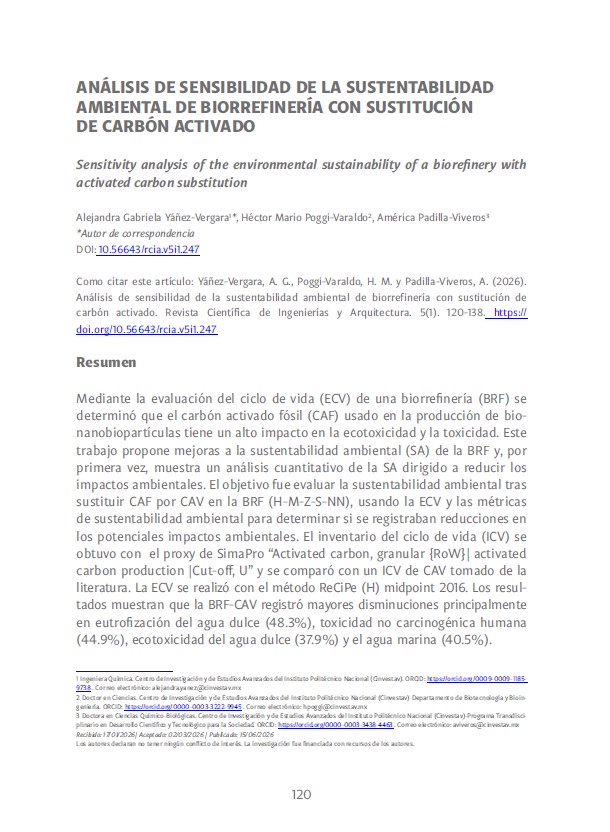
The Life Cycle Assessment (LCA) of a biorefinery (BRF) determined that using fossil activated carbon (FAC) in the bionanobioparticles production stage carries a high impact in terms of ecotoxicity and toxicity. This work proposes improvements to the environmental sustainability of the BRF and, for the first time, presents a quantitative analysis of ES to reduce its environmental impacts. The objective was to evaluate the environmental sustainability of replacing FAC with activated carbon (AC) in the GBAER (HMZS-NN) BRF using LCA and environmental sustainability metrics, and to determine whether the potential environmental impacts decreased. The life cycle inventory (LCI) was based on the SimaPro proxy "Activated carbon, granular {RoW} | activated carbon production | Cut-off, U". It was compared with an LCI of AC taken from the literature. Environmental impacts were assessed using the ReCiPe(H) midpoint 2016 method. The results show that most significant reduction in environmental impacts was for the BRF-CAV system, primarily for freshwater eutrophication (48.3%), non-carcinogenic toxicity to humans (44.9%), freshwater ecotoxicity (37.9%), and marine ecotoxicity (40.5%). The latter was the most significant reduction, from 14 to 8 person-years per functional unit (FU). The total normalized potential environmental impacts of the BRF system with CAF substitution for CAV were reduced from 41 to 27 person-years per FU, indicating that the use of CAV significantly improved the sustainability of the BRF system.
References
Arena N., Lee, J., y Clift, R. (2016). Life Cycle Assessment of activated carbon production from coconut shells. Journal of Cleaner Production, 125, 68-77. https://doi.org/10.1016/j.jclepro.2016.03.073
Ávalos-Rodríguez, M.L., Díaz-Abrego, M., y Rangel-Vargas, J. M. (2025). La sostenibilidad en los posgrados. Creación de contenidos ambientales en el Doctorado en Innovación UVEG. Revista Electrónica en Educación y Pedagogía, 9(16), 128-144. https://doi.org/10.15658/rev.electron.educ.pedagog25.06091606
Escamilla-Alvarado, C., Poggi-Varaldo, H. M., y Ponce-Noyola, M. T. (2017). Bioenergy and bioproducts from municipal organic waste as alternative to landfilling: a comparative life cycle assessment with prospective application to Mexico. Environmental Science and Pollution Research, 24(33), 25602-25617. https://doi.org/10.1007/S11356-016-6939-Z/FIGURES/6
Escamilla-Alvarado, C., Poggi-Varaldo, H. M., Ponce-Noyola, T., Ríos-Leal, E., Robles-Gonzalez, I., y Rinderknecht-Seijas, N. (2015). Saccharification of fermented residues as integral part in a conceptual hydrogen-producing biorefinery. International Journal of Hydrogen Energy, 40(48), 17200-17211. https://doi.org/10.1016/j.ijhydene.2015.06.164
Escamilla-Alvarado, C., Ponce-Noyola, M. T., Poggi-Varaldo, H. M., Ríos-Leal, E., García-Mena, J., y Rinderknecht-Seijas, N. (2014). Energy analysis of in-series biohydrogen and methane production from organic wastes. International Journal of Hydrogen Energy, 39(29), 16587-16594. https://doi.org/10.1016/j.ijhydene.2014.06.077
Escamilla-Alvarado, C., Ponce-Noyola, T., Ríos-Leal, E., y Poggi-Varaldo, H. M. (2013). A multivariable evaluation of biohydrogen production by solid substrate fermentation of organic municipal wastes in semi-continuous and batch operation. International Journal of Hydrogen Energy, 38(28), 12527-12538. https://doi.org/10.1016/J.IJHYDENE.2013.02.124
ISO 14040. (2006). Environmental management - Life cycle assessment- Principles and framework. En The Internation Organization for Standardization.
ISO 14044. (2006). Environmental management - Life cycle assessment- Reuirements and guidelines. En The International Organization for Standardization.
López-Hernández, V., Limón-Hernández, R., y Morales-Moguel, O. (2025). Diagnóstico de la generación de residuos en municipios del norte de Veracruz. Revista Investigium IRE: Ciencias Sociales y Humanas, 16(1), 136-158. https://doi.org/10.15658/INVESTIGIUMIRE.251601.06
Mendoza Rossano, J. A., Cruz Hernández, J., y Herrera Pérez, L. (2023). Determinación de parámetros físicos y químicos de digeridos de bagazo de agave (Agave angustifolia Haw.) obtenidos con pacas biodigestoras. Revista Chapingo Serie Agricultura Tropical, 3(2), 1-8. https://doi.org/10.5154/r.rchsagt.2023.03.10
Romero-Cedillo, L., Poggi-Varaldo H. M., Breton-Deval, L., y Robles-González, V. S. (2018). Biological synthesis of iron nanoparticles: 6th International Symposium on Environmental Biotechnology and Engineering.
Sagarpa (2022, March 9). Producción de coco y copra en México. Gob. Mx. https://www.gob.mx/agricultura/es/articulos/produccion-de-copra-y-coco-en-mexico
Sierra-Gachuz, H., Poggi-Varaldo, H. M., Sotelo-Navarro, P. X., Escamilla-Alvarado, C., Sojo-Benitez, A., Barrera-Cortés, J., y González-Cardoso, G. (2022). Evaluación de la sostenibilidad ambiental de las Biorrefinerías de la Familia H-M-Z-S. En P. Sotelo-Navarro, A. L. Tecorralco-Bobadilla, C. Escamilla-Alvarado, G. Hernández-Flores, I. Nava-Bravo, J. A. López-Díaz, y H. Poggi-Varaldo (Eds.), Ambiente y bioenergía. Perspectivas y avances de la sostenibilidad (pp. 2-12). ABIAER A. C.
Sotelo-Navarro, P. X., Poggi-Varaldo, H. M., Chargoy-Amador, J. P., Sojo-Benítez, A., Pérez-Angón, M. Á., & Sánchez-Pérez, R. (2022). Environmental impacts of an HMEZS biorefinery. Revista Internacional de Contaminacion Ambiental, 38, 48-57. https://doi.org/10.20937/RICA.54332
PRé Sustainability (2019). Activated carbon, granular {RoW}| activated carbon production, granular from hard coal | Cut-off, U. En Ecoinvent v 9.0.0.35. PRé Sustainability.
PRé Sustainability (2019a). SimaPro database manual methods library. Report (v 9.0.0.35). PRé Sustainability.
PRé Sustainability (2019b). Spoil from hard coal mining {GLO}| treatment of, in surface landfill | Cut-off, U”. En Ecoinvent v 9.0.0.35. PRé Sustainability.
Vilén, A., Laurell, P., y Vahala, R. (2022). Comparative life cycle assessment of activated carbon production from various raw materials. Journal of Environmental Management, 324. https://doi.org/10.1016/j.jenvman.2022.116356
Victorino Ramírez, L., y Velázquez Cigarroa, E. (2018). Educación ambiental, cambio climático y sustentabilidad: Saberes locales y multidisciplinarios para el desarrollo. Universidad Autónoma Chapingo. ISBN: 978-607-12-0495-0
Yáñez-Vergara, A. G. (2022). Análisis de sustentabilidad de dos escenarios de gestión de residuos urbanos: biorrefinería que genera bioenergías, enzimas y nanobiopartículas (H-M-Z-S-NN) e incineración con recuperación de energía. Centro de Investigación y de Estudios Avanzados del Instituto Politécnico Nacional.
Yáñez-Vergara, A. G., Morales-López, C. E., Poggi-Varaldo, H. M., Sotelo-Navarro, P. X., Padilla-Viveros, A., Matsumoto-Kuwabara, Y. (2024, noviembre 13). Influencia del carbón activado usado en una biorrefinería tipo GBAER que produce biocombustibles, enzimas y bionanobiopartículas. Simposio Ambiente y Bioenergía. Veracruz, México. Presentación oral.
Downloads
Published
Issue
Section
License
Copyright (c) 2026 Alejandra Gabriela Yáñez Vergara, Héctor Mario Poggi Varaldo, América Padilla Viveros

This work is licensed under a Creative Commons Attribution 4.0 International License.
Los autores/as que publiquen en esta revista aceptan las siguientes condiciones:
- Los autores/as conservan los derechos de autor y ceden a la revista el derecho de la primera publicación, con el trabajo registrado con la licencia de atribución de Creative Commons 4.0, que permite a terceros utilizar lo publicado siempre que mencionen la autoría del trabajo y a la primera publicación en esta revista.
- Los autores/as pueden realizar otros acuerdos contractuales independientes y adicionales para la distribución no exclusiva de la versión del artículo publicado en esta revista (p. ej., incluirlo en un repositorio institucional o publicarlo en un libro) siempre que indiquen claramente que el trabajo se publicó por primera vez en esta revista.
- Se permite y recomienda a los autores/as a compartir su trabajo en línea (por ejemplo: en repositorios institucionales o páginas web personales) antes y durante el proceso de envío del manuscrito, ya que puede conducir a intercambios productivos, a una mayor y más rápida citación del trabajo publicado.